
Our Portfolios tool allows you to visualize key portfolio metrics, compare your strategies against a prospect's portfolio, manage proprietary strategies and custom benchmarks, and more.
Getting Started
Portfolio Types
Portfolio Settings
Frequently Asked Questions
Getting Started
How to Create a New Portfolio:
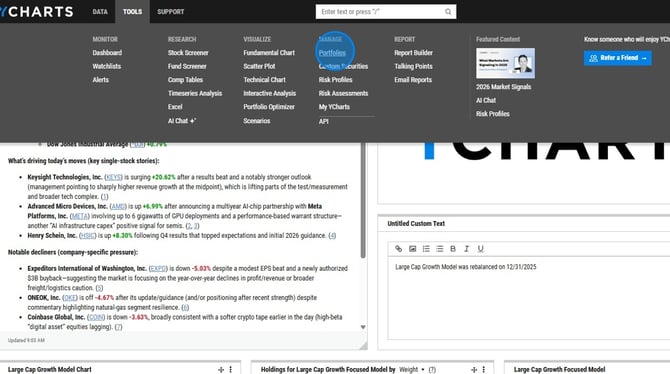
1. Hover over Tools and select Portfolios.
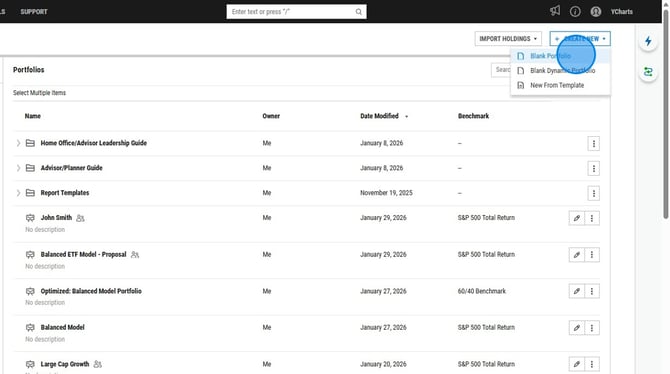
2. Select Create New at the top right and then choose Blank Portfolio.
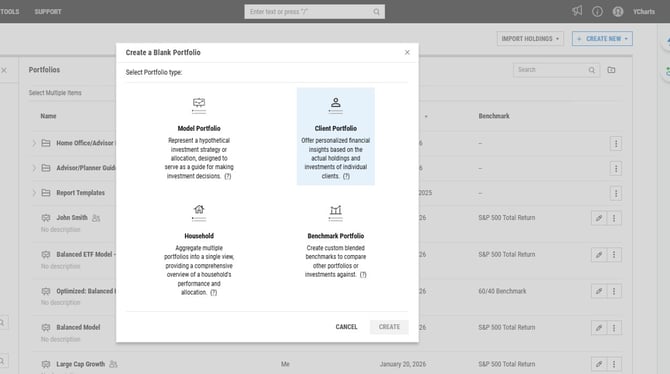
3. Select a portfolio type. Learn more about the different portfolio options here.
4. Fill out the portfolio settings at the top of the page. Learn more about each of these settings here.
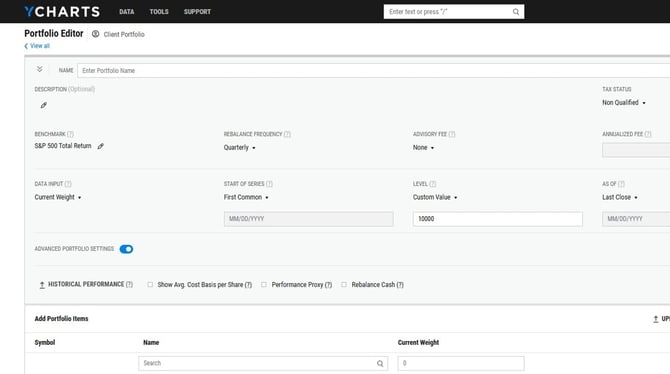
5. Enter the holdings and their dollars, shares, or weights at the bottom of the page.
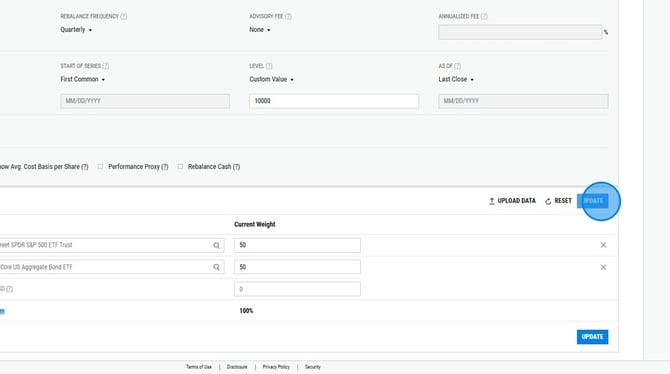
6. Select Update on the right side.
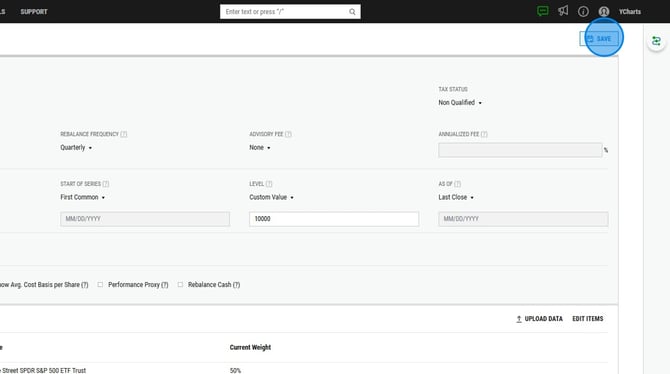
7. Select Save at the top right.
Portfolio Types
There are 4 types of portfolios, each one serving a different purpose.
- Model Portfolios: Represent a hypothetical investment strategy or allocation, designed to serve as a guide when making investment decisions
- All available inputs included
- Client Portfolios: Represents actual client holdings or a suggested client portfolio
- Introduces the ability to add cost basis information under Advanced Portfolio Settings
- Removes the ability to upload via target weights
- Benchmark: Represents a blended benchmark which can be used with other portfolios
- Removes the ability to add a fee
- Removes the ability to specify a benchmark
- Removes the ability to upload via dollars or shares
- Household Portfolios: Represents a household portfolio made up of additional existing portfolios
Portfolio Settings
- Benchmark: The security that is used to calculate a variety of risk metrics and compare performance against the model portfolio that you are creating. You can choose any index or model portfolio as your benchmark.
- Rebalance Frequency: Determines how often the holdings are rebalanced to their specified target weightings. To have the current and target weights match, choose "Daily" for the frequency.
- Advisory Fee: The advisory fee will be applied to the model portfolio that you enter. If you select a “Monthly” frequency, then at the end of each calendar month, your portfolio will be reduced by the following amount: (Annualized Fee / 12). If you select a “Quarterly” frequency, then at the end of each calendar quarter, your portfolio will be reduced by the following amount: (Annualized Fee / 4). If you select an “Annual” frequency, your portfolio will be reduced by the “Annualized Fee” you enter.
- Annualized Fee: This fee should include all advisory, administrative, platform, and manager fees.
- Tax Status: Applicable for the Transition Analysis feature within Client Portfolios.
- Data Input: Allows you to upload your holdings as dollar values, share values, and current or target weights.
- Start of Series: The start of the series setting determines the start date of the model portfolio you are creating.
- Earliest: Will begin the series history by finding the oldest security in your holdings, and starting the portfolio on the IPO or inception date of that security. The portfolio will then re-weight the portfolio to be allocated to the securities available at that time. For example, if your portfolio has 5 holdings at 20% each, but only 4 of the holdings are available on a certain date in history, then each holdings weight would be calculated by taking (holding weight) / total weight of available holdings) which means each holding would equal 20% / (20% + 20% + 20% + 20%) = 25%.
- First Common: Will find the first date that all holdings have a price or level, and allocate your portfolio based on the weights you input.
- Custom: Allows you to select a custom start date of your portfolio. As long as one of your holdings is active at the time of the portfolio start date, the portfolio will use the same logic as explained above in the earliest section.
- Level: The dollar value of your portfolio
- As Of: Determines the date of the custom level you have input is as of. If you selected a data input method besides target weight, the as of date is the date on which the selected data input's values apply.
Advanced Portfolio Settings
- Show Average Cost Basis per Share: Enter cost basis data for each holding, allowing for further analysis into the performance and returns of each position.
- Performance Proxy: Allows users to assign a security as a proxy to a holding for performance calculations. When adding a holding with a limited performance history, the Performance Proxy feature allows you to assign a proxy for the period before the holding was actively traded. Historical calculations will seamlessly use the proxy's data in place of the new holding, providing a more accurate and comprehensive representation of your portfolio's performance over time.
- Exposure Proxy: Allows users to assign a security as a proxy to a holding. The proxy security will be used in place of the holding for allocation and exposure calculations, providing a more accurate representation of their portfolio's allocation and exposure.
- Rebalance Cash: The Cash holding impacts the portfolio’s asset allocation statistics and will have a 0% return throughout the portfolio’s history. This feature will allow the cash holding to rebalance back to its target weight at the same frequency as all other holdings.
Frequently Asked Questions
Can I share my portfolio with a colleague?
- Yes, you can share your portfolio by selecting the share icon in the upper right corner of the page, between the alerts bell and reports button.
Will portfolios account for historical allocation data?
- These 'static' portfolios will not account for historical allocation data, it will assume all current holdings have been there for the life of the portfolio. Our dynamic portfolios do allow for historical allocation data.
Why does my portfolio have limited performance history?
- This is likely due to the Start of Series setting being set "First Common". To retrieve additional data, update this setting to either Earliest or choose a custom start date.