
Getting Started
Fast Track
Scenario Settings
Return Options
Frequently Asked Questions
Getting Started
How to Build a Scenario
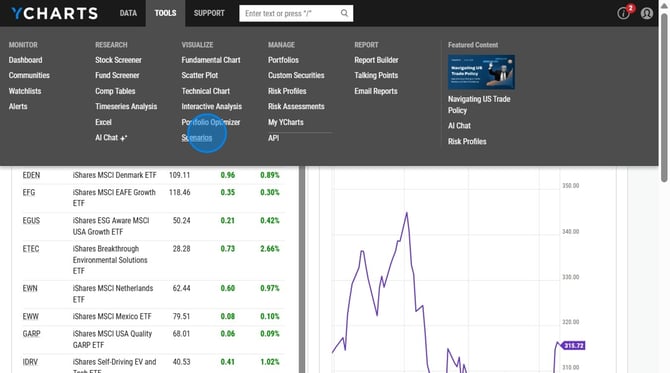
1. Hover over Tools and select Scenarios
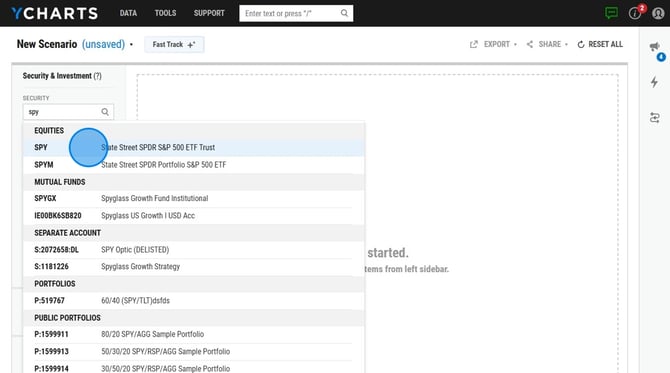
2. Search for a security or portfolio in the Securities section at the top left
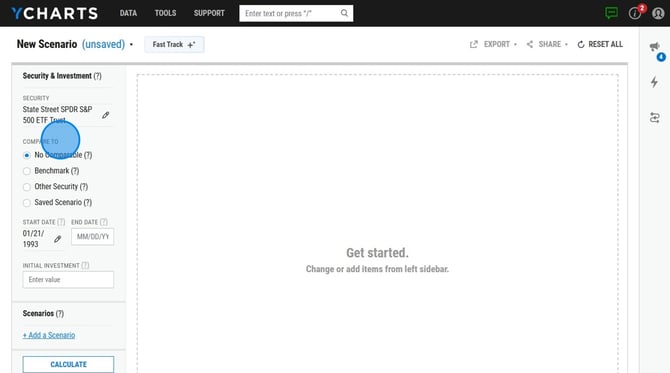
3. Select one of the options in the Compare To section if you're looking for a comparison.
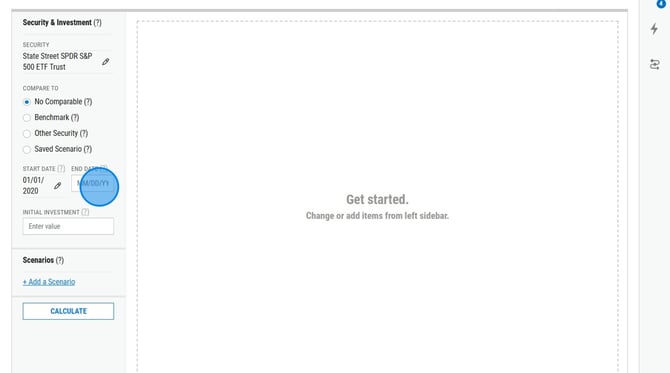
4. Select a start and end date for the scenario. Note: for future dates, the tool can only look as far into the future as there is history in the past.
5. Enter a starting investment value.
.jpeg?width=670&height=374&name=How%20to%20Create%20and%20Calculate%20Custom%20Investment%20Scenarios%20-%20Step%205%20(1).jpeg)
6. Select + Add a Scenario and give the scenario a name.
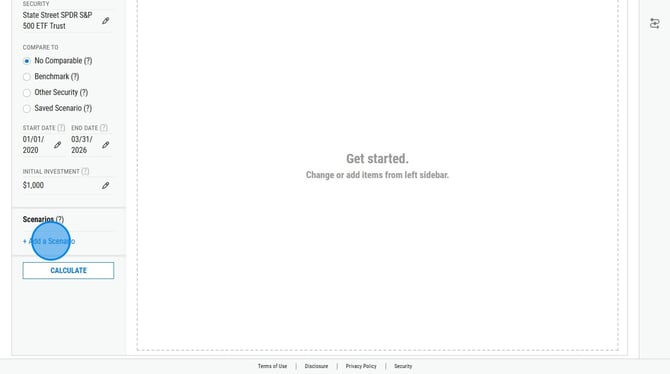
7. Select whether the scenario is a contribution or withdrawal in the Type section.
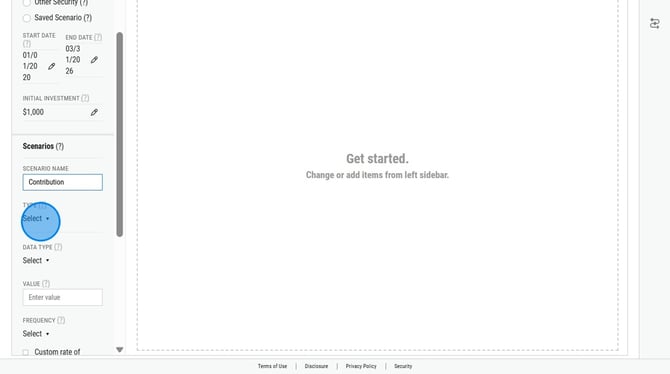
8. Select whether the scenario will use a value or a percentage in the Data Type section and enter in the value or percentage.
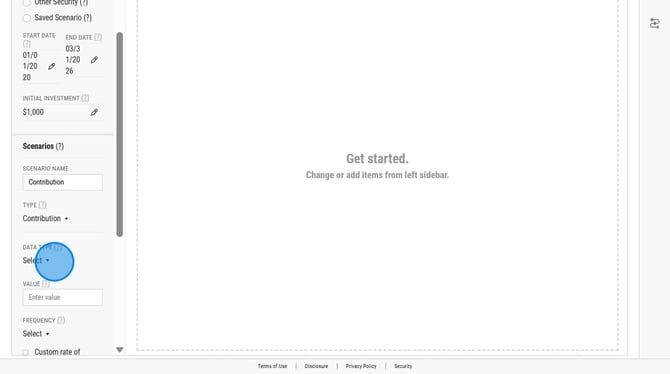
9. Select the frequency of the contribution/withdrawal in the Frequency section.
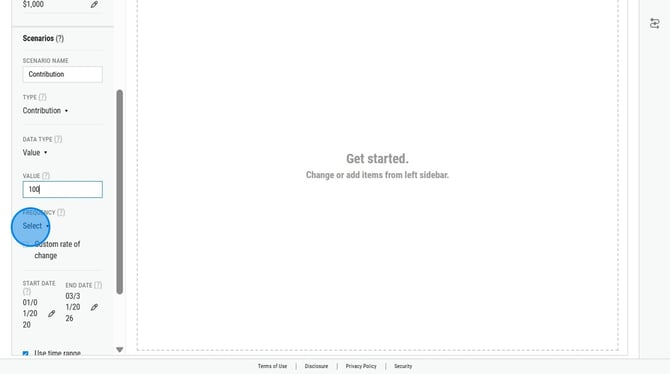
10. If you were looking to have the scenario increase over time, select the Custom rate of change checkbox and complete the fields. Then add in the start and end dates of the scenario.
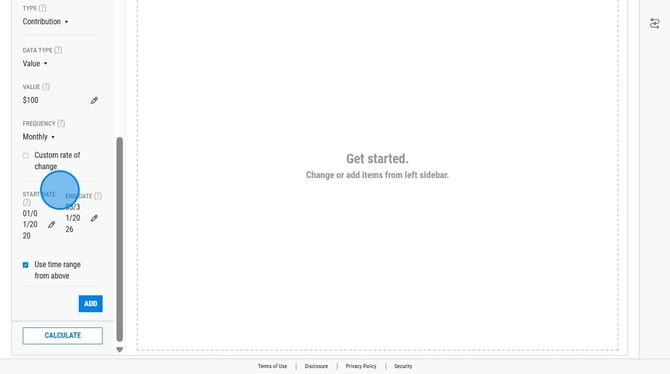
11. Select Add.
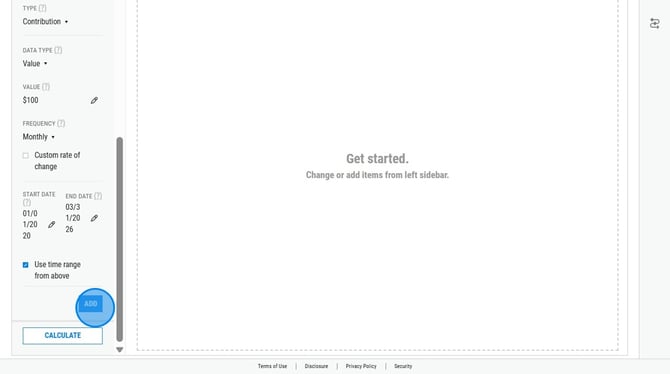
12. Select Calculate.
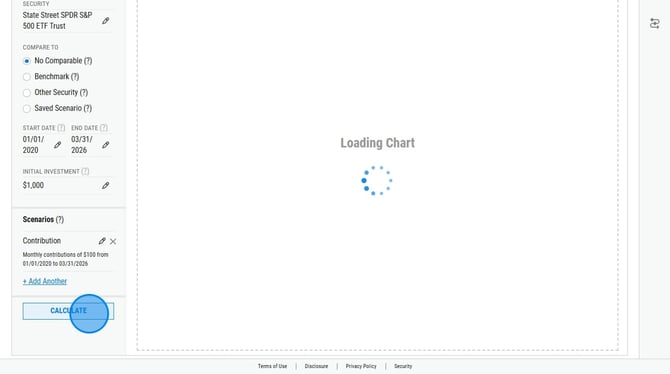
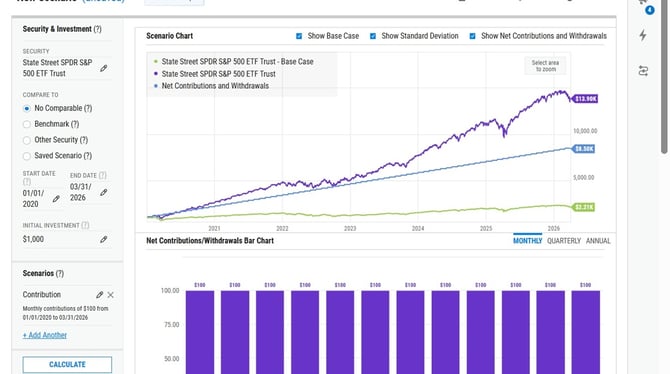
13. The scenario will now populate.
Fast Track
Fast Track uses natural language processing (NLP) to make scenario creation faster and more intuitive. Instead of adjusting inputs manually, just describe your scenario in plain language and Fast Track will build it for you.
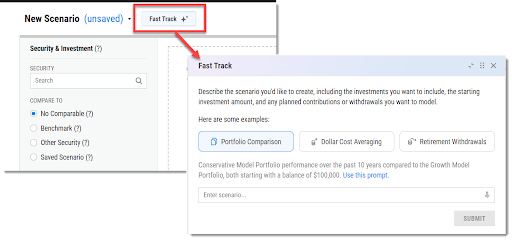
This table provides example use cases and ready-to-go prompts for Fast Track in the Scenario Tool. Each use case highlights a common situation—such as retirement income, college funding, or systematic savings. Just copy the prompt or use it as inspiration—then tweak the details to match
your client’s situation.
| Scenario | Lookback | Initial Investment | Pattern | Prompt |
|---|---|---|---|---|
| Scenario 1: Graduated Savings Plan | 20Y | $10,000 | $500/month, increasing 3% annually | Create a scenario starting 20 years ago with a ten-thousand dollar initial investment in SPY. Add monthly contributions of five hundred dollars and increase the contributions by three percent each year. |
| Scenario 2: Annual car purchase | 25Y | $1,000,000 | $50,000 lump sum withdrawal every 5 years (year 5, 10, 15, 20, 25) | Create a scenario starting 25 years ago with a one million dollar initial investment in SPY. Add withdrawals of fifty thousand dollars at year 5, year 10, year 15, year 20, and year 25 to simulate buying a new car every five years. |
| Scenario 3: Front-Loaded Savings (Inheritance/Bonus) | 25Y | $250,000 | $1,000/month for 10 years after lump sum | Start a scenario 25 years ago with a two hundred fifty-thousand dollar initial investment in SPY. After that, add one thousand dollars per month for the next ten years. |
| Scenario 4: Deferred Contributions | 30Y | $0 | No contributions first 5 years, then $2,000/month for 15 years | Create a scenario starting 30 years ago with $1 initial investment in SPY. Skip the first five years, then add contributions of two thousand dollars per month for the next fifteen years. |
| Scenario 5: Step-Up DCA | 30Y | $100 | $100/month first 5 years, $200/month next 5 years, $500/month next 5 years | Model a scenario starting 30 years ago with a one hundred dollar initial investment in SPY. Contribute one hundred dollars per month for the first five years, then increase to two hundred per month for the next five years, then increase again to five hundred per month for the following five years. |
| Scenario 6: Retirement Income - systematic withdrawals increased annually for inflation | 30Y | $1,000,000 | $60,000/year starting in year 6, +2% annually | Start a scenario 30 years ago with a one million dollar investment in SPY. Beginning in year six, withdraw sixty thousand dollars per year and increase that withdrawal by two percent annually for inflation. |
| Scenario 7: College Funding Plan | 25Y | $25,000 | $500/month until year 18 → $25,000/year withdrawals years 18–21 | Create a scenario starting 25 years ago with a twenty-five thousand dollar initial investment in SPY. Add contributions of five hundred dollars per month until year eighteen, then withdraw twenty-five thousand dollars per year for four years to cover tuition. |
| Scenario 8: Retirement Bridge (Gap Income) | 20Y | $750,000 | $40,000/year withdrawals for first 5 years, then stop | Model a scenario starting 20 years ago with a seven hundred fifty-thousand dollar initial investment in SPY. Withdraw forty thousand dollars per year for the first five years, then stop withdrawals after that. |
| Scenario 9: Legacy Gifting | 30Y | $1,000,000 | $100,000 every 10 years | Model a scenario starting 30 years ago with a one million dollar investment in SPY. Add withdrawals of one hundred thousand dollars at year 10, year 20, and year 30 to simulate gifts to heirs. |
| Scenario 10: Windfall + Retirement Spending | 30Y | $100,000 | $2,000/month until year 15 → $500,000 lump sum at year 15 → $3,000/month withdrawals starting year 20 | Create a scenario starting 30 years ago with a one hundred thousand dollar initial investment in SPY. Contribute two thousand dollars per month until year fifteen. In year fifteen, add a lump sum of five hundred thousand dollars. Starting in year twenty, begin withdrawing three thousand dollars per month. |
Scenario Settings
Type: You can either enter in a contribution or withdrawal for the scenario type. A contribution will add the amount you submit, while a withdrawal will take out the amount you submit at the frequency you have selected.
Data Type: The data type allows you to select either “percentage” or “value”. Percentage will multiply the value of the scenario at the time of the contribution or withdrawal by the percentage entered to calculate the amount. If you select “value”, the scenario will simply contribute or withdraw the value entered.
Value: The value entered can either be a percentage or a value based on the data type that you select. In either case, this value will be the amount contributed or withdrawn from your scenario. For example, if you have a monthly contribution of 1000, it will add in 1000 to your scenario value every month. If you entered in a 2% monthly withdrawal, it will calculate 2% of the value of the scenario at that time, and then subtract that amount at that time. It will then repeat this on a monthly basis.
Frequency: The frequency allows you to select monthly, quarterly, annually, semi-annually, and one-time for your contribution or withdrawal. This will allow you to choose how often your scenario should be contributed or withdrawn.
Rate of Change: allows you to adjust the the contributions or withdrawals in a scenario. Learn more about this setting here.
Return Types
When building out a scenario that has an end date in the future, you can choose between four different return types.
- CAPM Expected Return: uses the Capital Asset Pricing Model to estimate return based on market risk, using security beta, the risk-free rate, and benchmark returns. The formula is as follows: CAPM Expected Return = risk free rate + [5 year security beta * (annualized 5 year average return of benchmark - risk free rate)].
- 10 Year Return: applies a constant growth rate based on the security's average annual return over the past 10 years.
- Monte Carlo Return: models a wide range of potential outcomes by simulating 1,000 randomized return paths, based on asset class assumptions for return, volatility, and correlation. This return will utilize Capital Market Assumptions.
- Custom: lets you define your own annual return assumption, applied consistently across the projection period.
Frequently Asked Questions
Can I share a scenario with colleagues?
- Yes, once you create and save the scenario, you can select Share in the upper right corner and then select a share group.
Can I export the scenario to a PDF?
- Yes, once you have the scenario created, you can select Export in the upper right corner to generate a PDF.
How is standard deviation determined?
- The range will be 2 standard deviations above and 2 standard deviations below each 1 year, 3 year, 5 year, 7 year, 10 year, 15 year, and the final value.
What does the base case represent?
-
The base case will represent the value of the security without any contributions or withdrawals taking place.
When do contributions or withdrawals take place?
- The contribution or withdrawal will take place on the first trading day of frequency period selected. There is not currently a way to choose a specific date to have the contribution or withdrawal occur.
What type of return is calculated in scenarios?
-
Scenarios will calculate a money weighted total return.